Poems of Doris Trinidad, as contained in her book, Now and Lifetimes Ago, published by Giraffe Books, in Quezon City, 2001.
Doris Trinidad-Gamalinda is a Filipina poet who began her writing journey as a freshman writing for the campus paper at the University of Sto. Thomas, Asia’s oldest university. She has eight (8) children from her lawyer husband. One of them is the contemporary poet and teacher, Eric Gamalinda.
Mr. Ronald Kirkhouse reminds us, every now and then, to send a tender word. He has been a father of sort to me and I send him a hug and some tender thoughts – to go… 🙂 I will be back, folks.
Last February 25 was the 28th anniversary of the EDSA Revolution, also known as People Power I, in Philippine history. It happened from February 22 to 25, 1986. People gathered in the Epifanio De los Santos Avenue(EDSA) to topple the rule of then President, Ferdinand Marcos, dubbed a despot. The rest of the so-called civilized world hailed the event as a triumph of democracy, a glorious punch on totalitarianism. I was still in high school in the province, that time… Most Filipino bloggers have been born after that historic event, coincidentally. They have little or no idea what it was like to live under the Martial Law: an iron hand, so to speak…
EDSA People Power Revolution unseated a dictator and enabled free press, once again… / filamfunk.blogspot.com
My first serious blog talks about life 30 plus years ago, life as it was lived in a barrio – far away and almost forgotten. My siblings, my contemporaries and I, walked a lot – kilometers and kilometers of fields and unpaved roads. There was no tap water then, no electricity and very little money. It was a tough life, to say the least. It was a hunting and gathering kind of existence, just a little above. Well, our family had a concrete house – a proof, somehow, of a settled existence. We had clothes – hand-me-downs, ill-fitting ones, too worn out ones. Procuring rice was always a problem for us and eating fruits was a handy way to stave off hunger for the children, quite often. The stores in the area were few and literally, far between.
My siblings and I went to school, another difference, I suppose. We went to class, sometimes, with only avocados or ripe mangoes on our stomach; rice was costly. For lunch, rice and boiled native egg or rice and broiled dried herring. On certain days, it was rice and salt only. We made do… On weekends, we would cook bamboo shoots, banana shoots or banana heart in coconut milk, for our viands. These were staples, in our neck of the woods. We looked for mushrooms on the hills, on mornings of the rainy season. We gathered firewood, when freed from house chores and farm tasks. Ours was an agricultural community – rows and rows of rice and corn fields that saw peoples’ income flow in, only during harvest times.
It was a typical Third World scenario – of women balancing fruits and vegetables in woven bamboo containers over their heads (to catch the truck that would bring the produce to the towns and cities), of men on the way to or from the field (a machete or a cow in a leash, in hand) and, of children off to walk several kilometers (to run errands for their parents). It wasn’t Third World in my estimation then. Third World was a term I would only learn in college, at the state university in the metropolis. We knew there were things like Coca-Cola, Nescafeand Oreo biscuits, but we got to taste them rarely. When we did, it was at a rich relative’s house in the highway or at the town proper. We got to eat saltine crackers when sick – as a treat or a trick – to get well sooner, ahaha.
The headline of the day on September 21, 1972/ newsinfo.inquirer.net
Martial Law was a term we heard from the adults. It meant people were expected to sleep earlier. Fathers and uncles who got drunk must sleep in the house of their drinking buddies and not be caught loitering in the streets. It meant a huge picture of the country’s president was hanging in every classroom. It meant, schoolchildren were to recite the Patriotic Oath (Pledge of Allegiance to the flag), after singing the country’s national anthem, during the flag ceremony. ML meant that we were to be fed Nutriban (a kind of unleavened bread) and Nutrinoodles during recess. Nutrifeeding was a project initiated by our famous First Lady, Imelda Marcos, to address malnutrition. Martial Law meant extension workers would be visiting the farms periodically – to give out seeds, piglets and advice to the farmers.
People were discouraged to talk about the government and the governance process during those years – 1972 to 1986 (Martial Law was officially lifted in 1981 but Pres. Marcos remained seated). Or, if necessary, conversations must be done in hush-hush tones. Government officials – from the provincial level down to the village level – were holding office permanently. As children, we did not know that things were so. We just knew that our town mayor was a man feared and deferred to and, he was in office since we were born and would be there indefinitely. To have him replaced was unthinkable. Government, for the people in my barrio, meant that every year, there would be vaccination at the village school. Also, the village chieftain must be informed of the birth of new children – so he could go to town and register their names at the municipal record office.
For most of the folks, life was simple, poor and almost unchanging. Dirt roads, bamboo bridges and improvised school houses were the norms, back then. At times, classes were held under the mango trees, true. Not having enough licensed teachers was also a constant problem in rural places, like ours. I also remember, there was a public artesian well – one for every 100 households – I think. Among the problems of our folks, water sourcing would stick to my mind, long after I have left the barrio. It loomed large, I guess, because agriculture was our folks’ livelihood. And, there was very little water. One could imagine, things were worse during the dry season. The queue in the artesian well was usually longer than the line of people buying breads, in the bakeries in town.
Paving the roads in the barrios and connecting them to the towns and cities is an imperative in developing Philippines/ http://www.panoramio.com
In college, years later, most of the professors would use the term underdevelopment, to describe the rural situation I just outlined. They would say, it was due to the lack of technology and know-how plus, the problem of access to facilities and services. Likewise, there was the question of justice – how the folks are marginalized from the trading opportunities, how the bulk of commerce circulates only in the centers and how lack of infrastructures, in effect, isolates those communities. There was corruption – at the macro or national level of government – how the folks’ benefits and cash transfers are being spirited away from the coffers, to line the private pockets of those in office… I did not understand most of these, back then. The professors could as well be talking in Greek, I would hardly know the difference.
President Cory Aquino in her signature yellow dress, flashing the L (laban or fight!) sign in 1986.
Corazon Aquino would be ushered to the helm of power by the People Power event. She was the widow of Senator Benigno Aquino, Jr., the most vocal opposition leader during the Martial Law. Pres. Cory was the country’s first woman president and the first to address the U.S. Congress to report on how democracy has been restored, this side of the tropics. There, she pledged the restoration of the freedom of expression and assembly, as well as the freedom to trade, sans the cronyism that has been the practice, for almost two decades. President Aquino’s term of office would be plagued by instabilities and nine(9) coup d’etats. In an ironic twist of fate or, expectedly, she would be succeeded in office by a former general. Pres. Fidel Ramos was the country’s highest military officer, during the Martial Law. He was endorsed by Cory Aquino in the 1992 election.
A well-known action star, Joseph Estrada, would be elected president in 1998, to be removed from office two and a half years later, in an event known as People Power II. The Vice-President, Gloria Macapagal-Arroyo, would take over the Presidency and become the second woman to occupy the highest office in the land. Gloria Arroyo is the daughter of the country’s former president, Pres. Diosdado Macapagal, the man from whom Pres. Marcos wrestled the highest seat in 1965. Pres. Arroyo would seek legitimacy in the next election, 2004 – a contested and questioned poll. Thus, Pres. GMA would stay in office for nine(9) years. In 2010, 24 years after the EDSA People Power, things would come full circle – Pres. Corazon Aquino’s only son would be elected president. Benigno Aquino III or Pres. Noynoy, would occupy the highest office, in a continuing bid to align the Philippines towards the democratic ideals and bring the Filipinos closer to progress.
Ten (10) years after People Power or, starting 1996, roads would be paved in our town, including the barrio where I come from. Thus, children would no longer walk kilometers and kilometers to and from school. Tap water connections have been installed in the area much earlier, as well as electricity. There would be telephone lines, beginning 2000 and by 2010, there would be internet connections. Most of the facilities absent during my childhood would noticeably be present. Curiously, by mid-1990s, all the rice and corn fields there would be gone. Infrastructures seem to have been provided by the government, but agriculture and folks’ livelihoods seem to have been sidetracked. Even with concrete roads, electricity and phone lines already, the people in our place remain generally poor and malnourished. It is still a rustic place – women still balance vegetable bins on their heads and the stores in the area, still few and far between.
I am unsure how EDSA People Power I has helped the people on the ground. Or, if many remember the event for what it was. People Power I was an attempt by the enlightened, the middle-class and the educated, to unseat a dictator and to widen the so-called democratic space of a struggling, developing country. Have things changed much in the Philippines? I really don’t know… I observe the children in our barrio and find that their ways are already different – from what people of my generation have known. They are less timid and are heavily influenced by what they see and hear on the television and the movies. Those kids are hardly aware of the 1986 event, so vivid in the minds of the Filipinos in their 50s. It was an affair that took place years, years ago – before they have been born. I also observe the children in the big city… Most of the city kids know EDSA as a highway, a busy one at that. In school, children across the country have been taught about the event. Yet, for them, People Power I was a street-party like activity that old folks – fathers and mothers, uncles and aunts, grandpas and grandmas – went to.
EDSA highway, on any given day/ dzrhnews.com
Those four (4) days – people wore yellow shirts, yellow grafittis were thrown from the buildings in the metro and the celebration put into office, a Lady in Yellow. According to them, ‘Twas all yellow and merry. But all gone now. 🙂
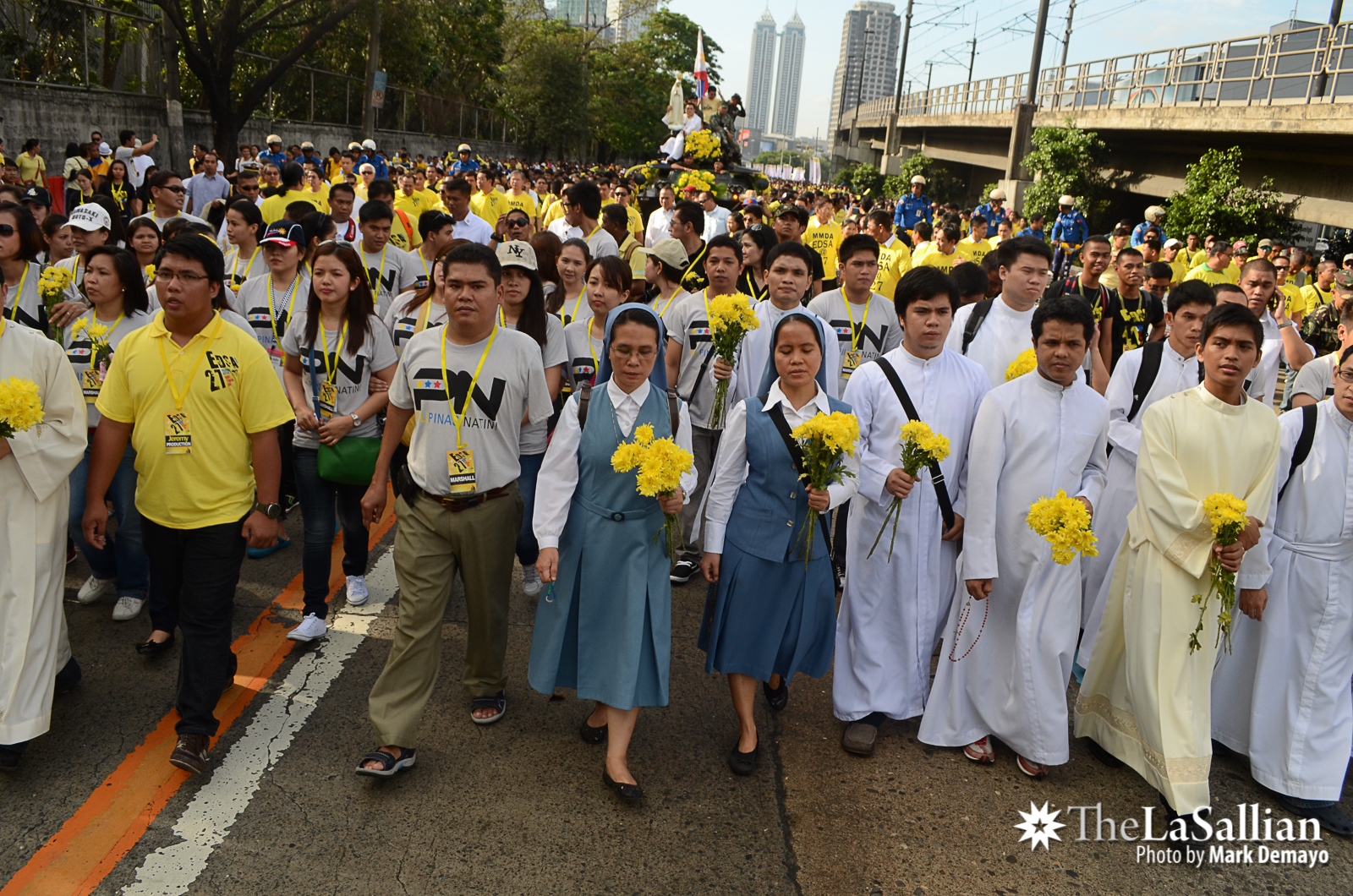
Yellow was the color of protest in 1986. People trooped to EDSA, armed with flowers, prayer books and hope for a better future. / thelasallian.com
Hello, people! I apologize to all of you for being gone for about six years, ahaha. My right hand has been injured… It is alright now. At least I can tackle typing painlessly, these days. I am so sorry for being absent without notice. I hope things have been well for you during the interim, my dear readers. Cheers and hugs! 🙂
By the way, this article was written before the injury, in early March. It was a post-EDSA anniversary musing, hoho. I was hesitant to have it published then – too sentimental, too personal and too mushy, ahaha. However, things are still a bit busy on this end. Thus, it has seen print. In the future, I might write another post on the same subject matter, employing a different approach and maybe, in a more serious tone. I beg your pardon.
So many things have happened, during my absence, hoho. For one, Pres. Barack Obama has been to the Philippines, yes. He delivered a speech and was wined, dined, photographed and fussed over, haha. I would have wanted to write about that. Maybe in the future, also… Am an Obama fan, is why, hahaha. 😉
It is already rainy season, over here. Typhoons have been all over the place! Very recently, there was typhoon Jose. Before him, it was typhoon Inday. Earlier, there was typhoon Henry. And prior, it was typhoon Glenda. That lady storm had a wide swath – exploring more than 10 provinces from the South to the North. It prided itself on having four (4) landfalls, uprooting hundred year-old trees and the eye of the storm, hitting the metro (Metro Manila) on the morning of July 16. Most of the towns hit are still without power two weeks after the devastation. The damage to properties was huge. However, human casualties was considerably low: 54. We must have learned some lessons from supertyphoon Yolanda, we hope… 🙂
Folks, this site is open for guest posting. Send your article to onholdcynicism@yahoo.com. I hope you will be kind enough to oblige this blogger… ^_^ On this note, our next post will likely be from a fellow Filipina blogger. Hope you, guys, are keeping well. 🙂
Ms. Yearstricken’s writings captivate in a sweet, no- fooling-around way. I imagine this lady blogger, an English teacher, has encountered and survived truckloads of grammatical errors, wrong usage and words in loose hinge, haha. She shares them with us in her posts – full of puns, fun and delight.
Pare the words down to their beauteous essence and serve them, as one does Japanese tea, I suppose that is how she treats the words on her pages. Her writings inform, move and challenge. They ask the reader to think and write from the heart, the brain and from one’s innermost – whatever that is… Hope this one will brighten your day and inspire us to write more and better. Cheers! 🙂
Writing is an exploration of the terrain of truth, and no one can anticipate its discoveries. It is a journey away from home, in search of home. Only those who travel the road know how lonely it can be.
Writing is both disrobing and dissembling. Above all, we seek to be known; and yet, our greatest fear is that people will see us as we really are.
Writing is a compulsion and a conviction entangled with the desire to have a voice that will not be silenced by death.
Writing is a setting out to sea. The sailor cuts loose the ropes and moves some small distance from the harbor, sails unfurled, only to find the winds have died down.
Writing is death. Long and protracted; blood, the only ink. Not writing is death. Quick but painful; the writer a mausoleum full of dead bones.
Happy, happy New Year to all!Hope 2013 was good to you and 2014 will even be better… 🙂 This was written a good while ago, as part of my project on romanticism in the Tagalog sites, an attempt am unsure if I could finish, ahaha. Keep your fingers crossed for me, guys… 😉
Let’s indulge the romantics in us, here’s Jessie J with We Found Love
and Francis Lai‘s Where Do I Begin? on YouTube. Thanks for the visits and the love, hope you’re keeping well. 🙂
The outpouring of support to the victims of typhoon Yolanda in the Philippines from the different parts of the world, is quite unexpected, moving and heart-warming. It is as if the volunteers, the rescuers and the donors – You – were trying to outdo the strength and the fury of the superstorm. You did not just extend money, goods and medicines. No. Your first-aid personnel and rescue teams came over promptly to help in the disaster areas, firsthand. Your governments likewise lent us helicopters, fast boats and planes: unasked. You did not just give us words of sympathy, condolences, prayers and well wishes. No. You sent over your hearts to enable the survivors to imagine – life is worth living still. Thank you… Maraming salamat po. Mabuhay kayo! 🙂
Thank you for reminding us: Love is real. Respect is still alive. Community of people is not a thing of the past. And it seems to transcend borders, races, statuses, politics, religions, ways of life, technological divides, boundaries – human or otherwise. People of all ages, from all walks of life, of different persuasions – coming together at one moment, for the cause of easing sufferings, of fighting squalor on this end. Your quick and warm response gave us hope, at a time when it felt like giving up was the easier, if not the better, choice. Over here, our hearts are swelling from gratitude and appreciation. Your aid, your help, your faith have made us believe again: Humans are connected by an invisible, never-ending chain. This connection seems to say: Life must go on.
Another morning in the Philippines, amidst the troubles/ journals.worldnomads.com
It is a hard thing. To begin again. To start anew. To pick up the pieces of broken lives, floating dreams and shattered promises. To look to the future, to envision tomorrow and to make plans – again. To believe in the here and now. To reconnect to the world at large and to the self within. In the midst of the chaos, confusion and uncertainties. Through the darkness, in the depths of sorrow, the devastation surrounding. It is tough. But we must…
Beyond the drama of rising from the rubble and the ruins, the challenge of rebuilding looms large in the horizon for the Filipinos. Can we, as a people, gather the strength to rehabilitate, to restore, to found anew? Can we go beyond the nearsightedness of our politics, the pettiness of our squabbles and the divisiveness of our daily lives? Can we put in again clean water, food, houses, school buildings, markets, sanitation systems, livelihoods, jobs, churches, means of transport in the disaster-hit areas? Can we put back the smiles in the eyes of the children that have seen dangers, deaths and destruction, at close range?
There is a thousand reason to continually despair, to stay broken. There is a thousand and one reason, to hope. To believe, despite the odds, it pays to be around and alive. When the cameras are no longer there to inform the world how our streets look like, how the tragedy’s victims are coping and how our politicians are scampering to clean up the mess – it remains in our collective hands to deliver the goods of unity and progress. And we have not much to go by, truth be told… Except, at one time, one sad time,our SOS was heard by the world, forging oneness among various and differing people – to lend a hand unconditionally. We will always have that.
As we survey the damage wrought by the violent supertyphoon, we remember our brothers and sisters who likewise suffered and lost from nature’s wrath – the victims of the Indonesian tsunami in 2004, the victims of the Haiti quake in 2010 and the victims of the Japanese quake, tsunami and nuclear plant explosion in 2011. We remember and share your pains, as we know that you and the rest of the world, now share and feel ours. Apparently, the grounds that we walk on are connected, as well as the oceans that seem to separate us – across cities and continents. Certainly, there is only one nature that nurtures and cares for us, the same nature that periodically gets into a rage and challenges humanity’s mettle and forbearance.
Disasters do transform people, individually and collectively, in more ways than one… They may harden the hearts and sensibilities of some, as they may soften the hearts of others, on some far ends. We do not really know… Those of us not directly affected can only sympathize, encourage and to some extent, inspire and be inspired in return. Indeed, it may take months for the country to regain its economic position, years to rebuild and, generations to heal the wounds… We can count the houses and buildings destroyed and compute their costs. We can calculate the livelihoods and businesses lost, and do estimates and plans for recouping them. What we cannot account for, with precision, is the extent and degree of damage to lives, homes, communities – to the relationships torn, suddenly, apart.
The Philippine business sector and the planners have already put their heads together and come up with the figures. Reconstructing the typhoon damage will cost about 6 billion dollars or 250 billion, in peso terms. Said amount is about one-eight of our annual national budget. Yolanda’s effect on the country’s GDP performance or income, on the other hand, is projected at 4% at the most. Yet, these figures only map out the financial and the business aspects of reconstruction and rehabilitation. Chances are, they hardly make sense to the woman in Tacloban City who will commence her life after the debacle – minus her husband and six(6) children. It remains the task of the people closest to the victim and the rehabilitation teams on the ground, to help her struggle, cope and believe – again and anew.
In business, the resources initially put in to get a venture rolling is called capital outlay. In this case, we may call the donations – humankind’s goodwill. From institutions as big as the United Nations, as powerful as the Swiss Bank, as known as the CNN, as revered as the Arab royalty, as established as Coca-Cola, as popular as Randy Jackson and Pink, to the unknown American, French, English, German, Japanese, Australian, Korean, African, Indonesian, who donated via credit cards, to the lowly employee somewhere, who sent over the equivalent of a day’s wage – to the thousand children all over the globe – who skipped lunches and opened piggy banks, so they could send a couple of dollars to the children typhoon victims in the Philippines.
A convergence of efforts, big and small – from soldiers and doctors packing their bags to help directly, to the call center agent donating her shopping money, to the President of Switzerland manning a desk, in a frantic bid to raise money for the victims – this relief fund appears to be about…
This particular instance of altruism by the world is more than governments aiding another, in a time of distress. This is more than UN, coming to help a Third world nation, in its regular aid roll. This is more than America, extending a hand to its former colony. This is more than Hollywood celebrities, in another act… It is people and institutions, established companies and start-up, tiny ones, popular, public figures and private, unknown individuals – humbled enough by misfortune to recognize sufferings of fellow human beings, urging them, “It is not your place to forage in the wreckage, roofless and wet. Please stand up.” It is a human voice, saying, “My little help can make a difference in the life of another.”It is humanity believing in itself, individually and collectively: It can affect changes, it can turn things around.
Stop hunger, stop stealing, bury and honor the dead and, put roofs over the heads of the children. These are men’s ideals, for thousands of years… For the first time, everybody – from the CEO, to the supervisor, to the utility man – thought these principles doable. He can pitch in, he can make these happen.
This appears to be not so much about the amount, as the currency and the form in kind and services, in which the donations come. Taken together, the voluntary contributions has the potential to do a geometric progression, to effect changes in people’s lives in ways we cannot accurately predict. It is a bit higher than your traditional charity. It is more potent than your ordinary aid. And in a sense, it is somehow more powerful than your usual capital. This is not your regular equity, though they may look to some as such. This came from those who did not turn away from the need of others, people they hardly know — screaming help from islands, the names of which they learned, only a few days ago… It involves the intangibles, the ideals and hopes of the donors and givers. This donation is a package of concern, care and hope. It is empowering both to the givers and to those given.
When one finally does the Math, it would seem that the sum of money, pledges, goods and services extended and will be extended to the typhoon victims, is a fraction of the long-run need. The sheer extent of devastation – more than six thousand villages flattened and laid to waste – may look daunting, at first glance… Still, this package is of extraordinary import, as it is also the first time that fund-raising for a cause has reached this pitch, coverage, scale and magnitude. How do Filipinos, who are at the receiving end of this gift, look at this particular gesture of the world? As huge tranches of money, to be distributed as your regular dole-outs, via the maze of our bureaucratic procedures? As another patronage tool, to be distributed to the wards? As largesse, to be sprinted away by our politicians, in the course ofperformance of duties? As business contracts in the wings, from which a select few may make a killing? As windfall money, to be spent eagerly and without thinking? This fund is sitting atop 5,000 dead bodies and 11 million discontinued and broken lives…
In traditional aid to countries, there is what is called local counterpart – an equivalent sum or a significant percentage of – to be generated domestically, plus the manpower and the efforts of the beneficiary. This, on the premise that the receiver stands to gain more in the outcome. Perhaps, this instance, the same principle should apply… Not all of the relief are in cash form, but a significant part of it, in goods and services. Thus, foreign engineer volunteers will be coming to the Philippines – to help build houses that can withstand storms better and to put in new sewage and sewerage systems; environmental experts will be flying in, to help assess the typhoon’s damage to our watersheds and bio-diversity; and yes, foreign psychologists, too – to help the typhoon survivors process their pains and losses, and help them get their bearings back. These donations are not in cash, though they come with price tags and unarguably, necessary and important in a rehabilitation effort.
Lastly, the bulk of relief, reconstruction and rehabilitation (cash and projects) will be managed and handled by private organizations, institutions and individuals. These entities will likely stay around for a good number of years, to monitor the developments and assess the impacts of their campaigns and efforts – to the target individual, family and community beneficiaries on the ground. The government, for its part, must coordinate the efforts – public and private – in a cohesive and effective plan to reconstruct and rehabilitate the affected regions and rally the nation’s support to realize the endeavor’s medium and long-term goals. In the long run, the government’s role is to see to it that the influx of funds and resources or the cash flow generated by the disaster, will foster growth in the affected regions and redound to the benefit of the disaster-stricken citizens.
The Visayas region is a prime source of migrant labor, internal and external. Thus, perhaps, one of the long-run measures will be what percentage of its working population can get back on their feet after the disaster, to resume productive and relatively normal lives again.
Right now, many tend to view the donations as cash transfers or subsidies to be distributed pronto. They are, the first three (3) months up to maybe, six(6). At least, a considerable portion of the funds and goods that are entrusted and pass directly through the government’s hands must be used, in the short-run, to aid the victims to survive physically and concretely. The first and early phase of helping the survivors is focused on relief– gathering, accounting for and seeing to it that they are alive, and putting in emergency measures on the ground. Mobilizing its social welfare arm (DSWD), the government must give out food, medicines and cash – without discrimination, elaborate scrutiny and long procedures.
Mobilizing its army and the local officials, it must search for and bury the dead, with all the haste it can muster. It must put the sick people and the traumatized in the hospitals, without delay. It must establish health centers, clinics and help desks in the disaster areas immediately, as it must ensure that sources of clean drinking water are available. The government must must likewise see to it that public markets are rebuilt promptly, the supply chain of basic goods in place and no hoarding and unfair pricing practices are happening in the disaster-affected areas. It must see to it that trade and commerce in the regions affected get back on business, in the soonest possible time. It must ensure that local governments at the municipality and city level resume office and function soonest. The national government cannot and must not take over the duties of the elected officials at the local level…
Allow me to be a pasaway (countercurrent) and say that it is not the government’s duty to provide jobs and to build houses for the people. It may do so, especially during extreme situations such as this one, but the cost at once limits the extent and length of time these can be done. Thus, it will be safe to assume, the jobs the government will create in the areas will be temporary, as well as the shelters.
Post-disaster scenario – the government’s duty is to shelter the children and see to it that they are fed and healthy, until such time that their families and surviving relatives are fit enough to work and provide for them. Likewise, it must make sure that schools are rebuilt and classes are resumed, as this is deemed crucial in facilitating normalcy for the children.The government’s role in job creation is to provide incentives for trade and commerce people, such that they will gravitate in the disaster-stricken areas and bring in employments. The government must signal the investors, through policies, tax incentives and short-term measures, that Leyte and Samar, the worst-hit centers, are growth areas. And they will likely be, as the bulk of the money, in the hands of the government and the private sector and donors, will be used for reconstruction of streets, bridges, public markets, school houses and homes.
The second and next phase of helping the Visayas will presumably be focused on reconstruction. Reconstruction will likely, largely be financed by the money, resources and efforts of the (private) donors, their local counterpart companies and organizations, with the help of NGOs and civic formations. The United Nations, for example, has already pledged to give fishing boats and start up capitals to small fishermen and small leasehold owners who are disaster victims. These will likely come in the form of direct grants or assistance, with the paper requirements probably shortened or minimized. The government, for its part, can also give out cash assistance for the first two years, plus open up loan windows for the farmers, fisherfolks and entrepreneurs, in order that they may put up and pursue their livelihoods again.
As the extent and depths of losses and destruction differ among families and across towns and villages, we can expect that the capacity and readiness to work, will also vary among the survivors. Thus, both the private and government arms involved in the effort, must make available various assistance menus and products (e.g., loan products) for the people.
Reconstruction is often proven to engender and bring growth in areas. Construction is the highest multiplier in most economies. But again, this sphere will likely be private sector-driven… The government’s role is to see to it that the procedures for doing them are in place and moving fast. More than that, it is duty-bound to inspire and coordinate the efforts and project long-term vision for the areas affected and the people therein.Voluntarism still plays a big part in the reconstruction phase. The national government arms that will be implementing projects on the ground in the disaster-hit areas will likely be line agencies, with minimal manpower at regional and town levels. They can very well employ the help of individuals in doing site visits, inventory and documentation of reports.
Likewise, reconstruction not only means setting up infrastructures, but also planting trees in the Visayas region. There are organizations and donors that have committed to doing this and they will likely employ the farmers and the locals. But private companies may and can incorporate this endeavor in their social responsibility programs, as partners.
The crucial phase is rehabilitation of the damaged areas and destroyed lives and communities. After surveying the damage and doing the inventory – houses, farms, stores, businesses, roads, private establishments and public facilities and infrastructures – those involved in the relief, reconstruction and rehabilitation program of the disaster-affected areas will likely sit down and decide what part of the effort can they take, deliver and how – given their organizations’ capacity, manpower, resources and commitment to the program. They will likely set targets, deadlines and measures – quantitative and qualitative; short, medium and long-term goals. In a sense, rehabilitation starts at the early phase of helping the devastated population, and ends when the set goals have been met and evaluated. Some areas have been hit from villages, to towns and up to cities. Some areas have been struck at village level only, while others, up to municipalities.
Just by looking at the Google pics of Tacloban City, before and after Haiyan, it looks like that part of the Philippines, is to be rebuilt from the ground up. Architects, engineers, business people, community planners and community organizers, as well as civic organizations, will probably play a big role in envisioning a brand new and invigorated Tacloban and making it happen.
Philippines, as a country, is not only archipelagic and disaster-prone. About 10% of its adult population does not even earn three (3) dollars in a day and probably, 30% does not even earn the set minimum wage. The Visayas region, Samar in particular, is historically, traditionally poor and conflict-ridden. Perhaps, the business side of the Yolanda disaster is: This could be Samar’s chance to rebuild its agriculture on a stronger ground and bring its commerce to a higher gear. On the other hand, Tacloban City is a port. Thus, this rebuilding effort could be its opportunity to establish another, bigger and more modern business hub or center in Central Philippines. But perhaps, we must not also forget that the business people, the entrepreneurs and the professionals in the areas have also been hit badly by the disaster. Thus, the manpower for the effort will likely be composed of people who are also dislocated, tired and suffering from temporary or long-term setbacks.
The Philippine government’s role is to inspire the relief, reconstruction and rehabilitation efforts – that it can be done, with enough or sparse funds, with adequate or insufficient manpower. Inspiring confidence and showing decisiveness is the government’s chief role in this first of a kind debacle and opportunity. It must inspire the donors, the investors, the international community, the overseas workers, the local business people, the mass of Filipino people not directly affected by the disaster and the people affected and badly-hit by Yolanda – make everybody believe that the impossible can be done – that hope can be found in hopeless places and situations…
The government must have a blueprint of its impossible dream for the Visayas region that the people will believe, take as their own and see through to completion. Through the national economic planning (NEDA), trade (DTI) and agriculture (DA) arms, the government must provide direction to the frontliners who will rebuild the disaster-stricken areas. With or without this disaster, the national government’s duty remains to be – governance of the whole country…
At the end of the day, or the years, or the decade – it remains the local citizens’ imperative to rebuild their family lives, communities and societies. The challenge and the stake to get up from the ground are higher for them – that is where they grew up, have lived, have buried their dead and that is the place and the community they hope to pass on to their children… After all, that is what the relief package of the world must be about, for the typhoon survivors to live, live for the world… And if possible, with grace and dignity – not foraging, not homeless, not waiting for the relief and pity of other people…
A lot can probably be said and supposed about supertyphoon Haiyan or Yolanda, and how it so moved, alarmed and touched people around the world to give help. Maybe it is the digital and interactive technology that enabled giving and donating easier and faster. Maybe it is the state-of-the-art broadcast, the wide reach of cable services and the availability of the CNN channel in most of the world’s urban centers. Maybe, it is people coming to terms with the reality of climate change as an urgent world issue. Maybe it is hearing the panic in the voices of Chris Ducker, Paula Hitchcock and Anderson Cooper as they were reporting live from the Philippines, right in the eye of the super storm, in an apocalypse-like setting – but not some movies directed by Steven Spielberg or Mel Gibson…
Maybe it is the sight of wet children asking for food. Or, the confused adults without the energy and means to bury the scattered dead. Maybe it is the extent of the devastation, in so short a period of time, shown through the TV screens. Maybe it is the sight of so many people utterly lost and miserable… Maybe it is all these and the realization that lives could be snapped out that fast and easily… In these hurried and callous times, millions of people all over the world saw another person’s sufferings as his own. And did something about it: They chose to give. We chose to give… Maybe not all about Haiyan pertains to destruction and misfortune. Maybe it is also about faith, faith in our connected and collective humanity. Maybe, the world felt the human species to be under siege and for a moment, understood – redeeming and saving the self is by recognizing and redeeming the other.
This week’s news already carry different headlines, as Haiyan’s survivors have started to labor in obscurity, picking up the pieces and beginning again, in these hard times. The rest of the world will carry on, as before, perhaps …
But maybe, in the future, it will be recalled that at one point, the Filipinos’ misfortune, this side of the tropics, gave the world the courage to give openly and willingly… This gift of compassion, in turn, gave us the wherewithal and the strength to start again, press on and meet life – with its violent quakes, pounding rains and merciless winds.
And the intersection of that single act of generosity and acceptance, can perhaps be called – humanity’s collective soul, shining through… 🙂
Tagged as the biggest and strongest cyclone to have landed on the planet, this cathastrophe visited via the regular storm path: Philippines. Locally called Yolanda, the super typhoon wrecked havoc on the Visayas region, particularly in the island of Leyte, 573 kilometers, south of Manila. The nightmarish storm hit the ground on the dawn of November 8, well on to the next day and did rampage for the next 48 hours. Official tally of casualties as of today is 1,841, eighty percent of which are from the Leyte-Samar area. 6, 498 villages have been affected, across nine (9) regions of the country. Disaster officers, however, estimate 10,000 people injured and missing; possibly dead. Total number of persons displaced by the calamity – 600,000.
We are at the tail end of the rainy season here. Normally, we experience typhoons right after the All Soul’s Day. Thus, a storm on the 3rd or 4th of November is considered ordinary or even expected, in these parts. But this one came a bit late, on the edge of the 7th – with trees swaying to the tune of the howling winds – slamming right into the towns and cities of Central Philippines. Experts hailed Haiyan as stronger and faster than Hurricane Katrina and Super typhoon Sandy combined. Indeed, Yolanda’s wind strength, coverage and speed is beyond what we, Filipinos commonly encounter. Or, go through. Or, escape from… No country or people is prepared enough for a natural disaster of this magnitude and proportion.
The storm pounded Tacloban City, Leyte province’s capital. Buildings were destroyed, houses flooded then eroded, and, the whole city was inundated by the storm surges from the nearby bay. In its wake – trees, people, animals, vehicles and huge amount of debris. Whole communities were flattened, brought to the ground, laid to waste… In the adjacent towns and in the remote villages, dwellings made from light materials (though reinforced) did not stand a chance. This extra-strength typhoon simply swept everything and every one in its path. Power lines were cut off, phone lines were down and food and water supplies vanished, just like that. Parents looking for their children could not find their way, children looking for their parents got lost and in the dark and pummeling rain, families were separated. Some, forever.
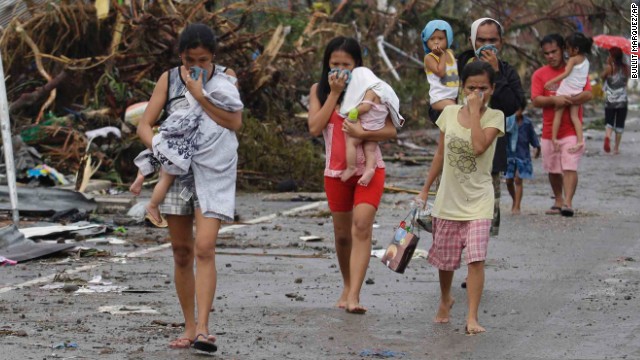
Evacuees cover their noses as they trek the roads to safety as bloated, dead bodies are yet to be buried/ http://www.cnn.com
If we try to wrap our heads around the idea of surviving a violent storm in a big group of islands, like the Philippines, we would have a hard time. This archipelagic country is host to 19 typhoons a year, at least three (3) of them are called super. It depends on where the storm would pass, hit (landfall) and exit, the length of its stay and the strength of the dances nature would do. It is a little like a lottery, with misfortune as the prize (no pun intended). Whenever a typhoon is expected in an area, foundations of houses there are strengthened, roofs are repaired and residents near bodies of water are evacuated. As the moving wind rants, raves and stomps – we run, flee and scamper to dry, higher and safer grounds. Filipinos are used to it, familiar and somehow, adjusted. Or, so we claim… One or two volcanic eruptions annually, a landslide here, three earthquakes there and periodic flooding. But we suffer each time; whether our immediate zone is directly affected or not. Regardless if the disaster, hit our front door, right into our living room or, it happened some 600 kilometers away.
We feel small, helpless, insignificant – just like the rest of the world watching the media coverage from CNN via the cable. We would like to help the victims in our own way, concretely — some shelter, jackets, hot water or even just coffee or soup. At one time or another, we have been there: on the side needing aid, assistance, comfort. Or, at the very least, seeking a glimmer of hope. From the screens of our television sets, the happenings are too distant, yet too familiar and too surreal. Mothers crying softly, fathers staring dumbfounded and confused children wailing, there’s just too many of them. In their faces – fear, pain and sorrow – all too deep, too recent for words. The hourly news flash updates on impassable roads, looting of supermarkets, warehouses and malls and, relief trucks stalled on the way to the victims. Most devastated communities are in the coastal areas or far-flung villages; rescue and relief operations are logistically long and difficult.
Three days after the storm’s landfall, it was found out that the nearby islands of Samar were also badly damaged. Historically, Samar is one of the country’s poorest provinces. It turned out, casualties in the Eastern and Western Samar was close to 400 and more than 2,000 villages in the area, have been badly affected by the storm. On the other hand, Bohol province, where a strong quake occurred less that a month earlier, was also hit by a series of gigantic storm surges during Haiyan’s rampage. Likewise for Cebu, where death toll from the super typhoon reached 63.
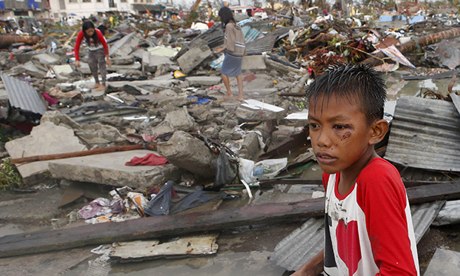
War has its signature image, that pair of haunting eyes asking the whereabouts of its loved ones. We keep on seeing it in the last five (5) days – on the TV screens, on social media’s most recently uploaded pics and videos and, on our PC monitors. There is no war, no. Yet, the manifestations are too telling – dead bodies, survivors foraging through the wreckage, in the midst of cadavers, and hungry, desperate people fighting over food, water and blankets.
The post typhoon scenario imitates that of a civil war. Children need immediate help/ http://www.theguardian.com
We change the channel, shift to another platform (to get more of the same) before dialing the number for the possibility of donating. It’s not enough, we know inside that that little help we are extending will hardly be enough. But we hope and pray to high heavens that it will succor the tragedy’s victims somehow. Somehow… We, too, are desperate. We, too need assurance that things will get better. After all, it’s not everyday that people loot supermarkets and dead peoples’ homes. It’s not everyday that people throw decency to the wind and elbow the next fellow for a can of sardines. No. But deep inside, we ask ourselves, “Had we been in that same situation, would we have done the same?” Surprisingly, we are not surprised by the answer: Yes.
*Interested and concerned parties may donate through the hotlines and websites of the UN Food Programme, the Red Cross and CNN. Private efforts and private groups soliciting support and donations for the typhoon victims are encouraged and welcome. If you are sending over items, easy-open canned goods are preferred, also bottled water, rice, blankets and jackets.
Most victims are in the evacuation areas or in the streets thus, they have nothing to cook with just yet. For now, edible and usable items that could be packed and handled easily are preferred and would also make it easy for the volunteers. Most relief efforts are using big trucks, most roads are still hard to negotiate or dangerous and the airports in the typhoon-hit areas as well as the electricity and phone connections are all down.
We all want to help, but let us also be patient. Donation of helicopters, aircrafts and seacrafts from really wealthy bloggers and their families are most welcome. Just kidding. 😉 Actually, am half serious. It seems the rescue and relief operations will speed up if the government had more of them as most victims are in islands, islets and isolated areas. Finding and burying the dead is also on top of the agenda. It’s almost like a war, over here. The atmosphere is such that most of us are down because of this disaster.
Let us all hold hands, this is a catastrophe that visited not just us, Filipinos, but all of mankind. You are with us, we know … Thank you. 🙂
Kind words and warm thoughts will be accepted, too. The blogger here is fine, thanks to dear bloggers who came over to ask and extended concerns. Hugs to all. 🙂 🙂
Top of Tuesday’s news was the 7.2 magnitude earthquake that hit the island of Bohol, 562 kilometers, south of Manila. The tremors reached onto nearby Cebu, destroying churches, hospitals and other structures. Bohol is a top tourist destination famous for its pristine waters, Chocolate Hills and the world-renowned Loboc Children’s Choir. The church where the children regularly sing, collapsed. The Basilica del Sto. Nino in Cebu, the oldest Catholic church in the Philippines, was also badly damaged.
Wednesday morning’s report said the number of casualties was less than 100. By the evening, news announced more than 140 dead bodies found and still counting. It has been raining very badly for days in most parts of the country, making the disaster bigger, darker and more confusing. Rescue and relief operations are ongoing. Movement of the tectonic plates, geological experts explain the disaster’s cause. The Bohol-Cebu quake was pronounced worse than the 2010 Haiti quake and is said to be 32 times stronger than the Hiroshima bomb.
The August 2012 Samar quake was 7.6 in Richter scale, but that disaster left only a few casualties. The 1990 Northern Luzon earthquake was 7.9 in magnitude, with 1,621 on its death toll (I was a teenager in the metropolis that time, tremors reached Metro Manila and for two months, we lived in fear – observing cracks in the wall and on the streets as we went along our routines).Topping the list of worst quakes was the 1976 earthquake in Mindanao, one that had a tsunami in its wake – death toll was 4,791. Unfortunately, we do get a lot of natural disasters around these parts, thanks to our rather exciting location: in the center of the world’s Ring of Fire, hoho. 🙂
Part of Bohol’s allure is for tourists to take a boat ride along its wide rivers, surrounded by verdant hills and mountains/ travelexplorebeyond.com
Bohol is known for its Chocolate Hills, a series of mounds that grace the island’s spectacular landscape/ de.paperblog.com
The famous Loboc Children’s Choir showcasing the island of Bohol in the background/ faxiamen.com
The biggest population of Philippine tarsier, one of the smallest primates, can be found in Bohol/ en.wikipedia.org
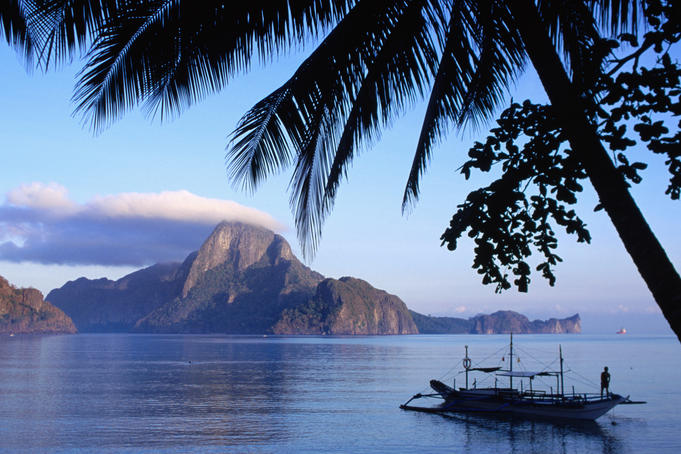
I was in El Nido, Palawan the first time, last September. El Nido is another top tourist destination in the Philippines, known for its clear water and gigantic limestone rock formations, similar to the Ha Long Bay in Vietnam. It was a pit stop in the Amazing Race reality show and the last scene in the latest installment of the Bourne Legacy series (a paradise-like island where the escaping movie couple, Jeremy Renner and Rachel Weisz, found themselves). My sister and I were there for five days, but we did not see much. The coastguards would not allow tours of the islands and the beaches: Philippines was then in the middle of a supertyphoon, Odette. We spent most of our time by the door of our hotel that was conveniently beachfront, with the giant sea waves lashing the shore and the windblown talisay leaves flying in our faces. For days, we felt marooned in the island said to be one of the country’s best.
On our last day, the supertyphoon has already landed, the coastguards allowed several groups to venture out nearby. We did get to see some of the gigantic limestone rocks, 13 to 15 million years in the making. From our boat, the cliffs look like ancient cathedrals – dark, foreboding, uninhabited. Dark blue waters with huge, undulating waves, against the gargantuan rocky mountains – untamed nature, up close, live. They take one’s breath away and leave one speechless. And, we weren’t in the choicest parts of El Nido yet…
We had a swim in a beach several kilometers away from the town and were served a sumptuous lunch. Then, on to another beach in another giant rock shelter, close by. As our boat was inching towards the shore, a storm hit. It was my second time to experience a sudden and violent cyclone in the open seas. The rain was pounding, the wind was merciless and it felt like we were in the middle of nowhere. We were actually in an islet, somewhere in the Bacuit archipelago, just a few kilometers away from Malampaya. All tourists in the five boats that made that trip ran for cover, by the shore. There really was nowhere for us to go. We were like rodents scattered in different parts of the shore, ravaged by the storm, about to be carried away by the giant waves, almost…
The dark cliffs of El Nido have withstood raging storms for millions of years/ togiexplorer.com
Living in the Philippines is quite exciting. Soon as you’re thinking you’ve had it bad, you open the TV or your computer and immediately, news of disasters greet you. Hardly a month passes by without a catastrophe visiting our group of islands – storms, floods, earthquakes, landslides or sometimes, a combination of. And these do not include the man-made disasters, my friends… The politicians in our country are always busy, needless to say. It’s a tough job telling and assuring the people, the constituents, to hang on – tomorrow, life will be kinder.
It’s also rough for the public school teachers and their pupils – every calamity spells ruined classrooms, changes in class schedules and begging politicians and rich donors for money — for the reconstruction of the damaged facilities. Of course, farming is usually badly hit and every year, agricultural output slides down. There is still a huge market for the insurance of small farms, leaseholds and fish pens: It begs to be in the top priority. Still, corruption at various levels manage to thrive and how…
The country’s previous administration is currently being investigated – for appropriating privately funds in billions – earmarked for farmer victims of previous typhoons. Hope the current batch of politicians, local and national, will not make hay out of the Bohol-Cebu tragedy. And hopefully, the peoples’ attention and concern for the disaster’s victims will extend beyond the days when said episode is top of the Yahoo News or Twitter’s trending topic.
I don’t know… From my experience, it is not really the gravity of the misfortune that causes a victim severe setbacks, but seeing and feeling the apathy of others who know about the big, consequential disaster, but treat it much like yesterday’s news. 🙂
Bohol’s Loboc church collapsed/bbc.co.uk
Century-old structures were not spared in the Bohol quake, people are still nervous about aftershocks/ in.news.yahoo.com
Several roads in Bohol have been damaged and impassable/ abc.net.au
The neighboring Cebu City was also badly hit/ bbc.co.uk
Attending to the sick and the injured first/ headlineasia.com
More than 1,200 aftershocks have been recorded since the original 30-second earthquake occurred. Authorities count 10 historic churches as badly damaged, as well as several hospitals and around 400, 000 families affected. Property damage estimate was placed at Php80 million, while the government has, so far, allocated Php98 million emergency and relief operations fund. Rescue operations are still ongoing, for the hundreds injured and missing in the tragic Bohol-Cebu quake.
Did I say that we, Filipinos, are a resilient lot? Disasters and all, we do manage to come around. More or less… 😉 🙂
Fortune knocks but once, but misfortune has much more patience.
* Ralph Fiennes reads Pablo Neruda’s poem, Ode to the Sea
Here surrounding the island, There΄s sea. But what sea? It΄s always overflowing. Says yes, Then no, Then no again, And no, Says yes In blue In sea spray Raging, Says no And no again. It can΄t be still. It stammers My name is sea.
It slaps the rocks And when they aren΄t convinced, Strokes them And soaks them And smothers them with kisses.
With seven green tongues Of seven green dogs Or seven green tigers Or seven green seas, Beating its chest, Stammering its name,
Oh Sea, This is your name. Oh comrade ocean, Don΄t waste time Or water Getting so upset Help us instead. We are meager fishermen, Men from the shore Who are hungry and cold And you΄re our foe. Don΄t beat so hard, Don΄t shout so loud, Open your green coffers, Place gifts of silver in our hands. Give us this day our daily fish.









 35andupcynicismonhold